

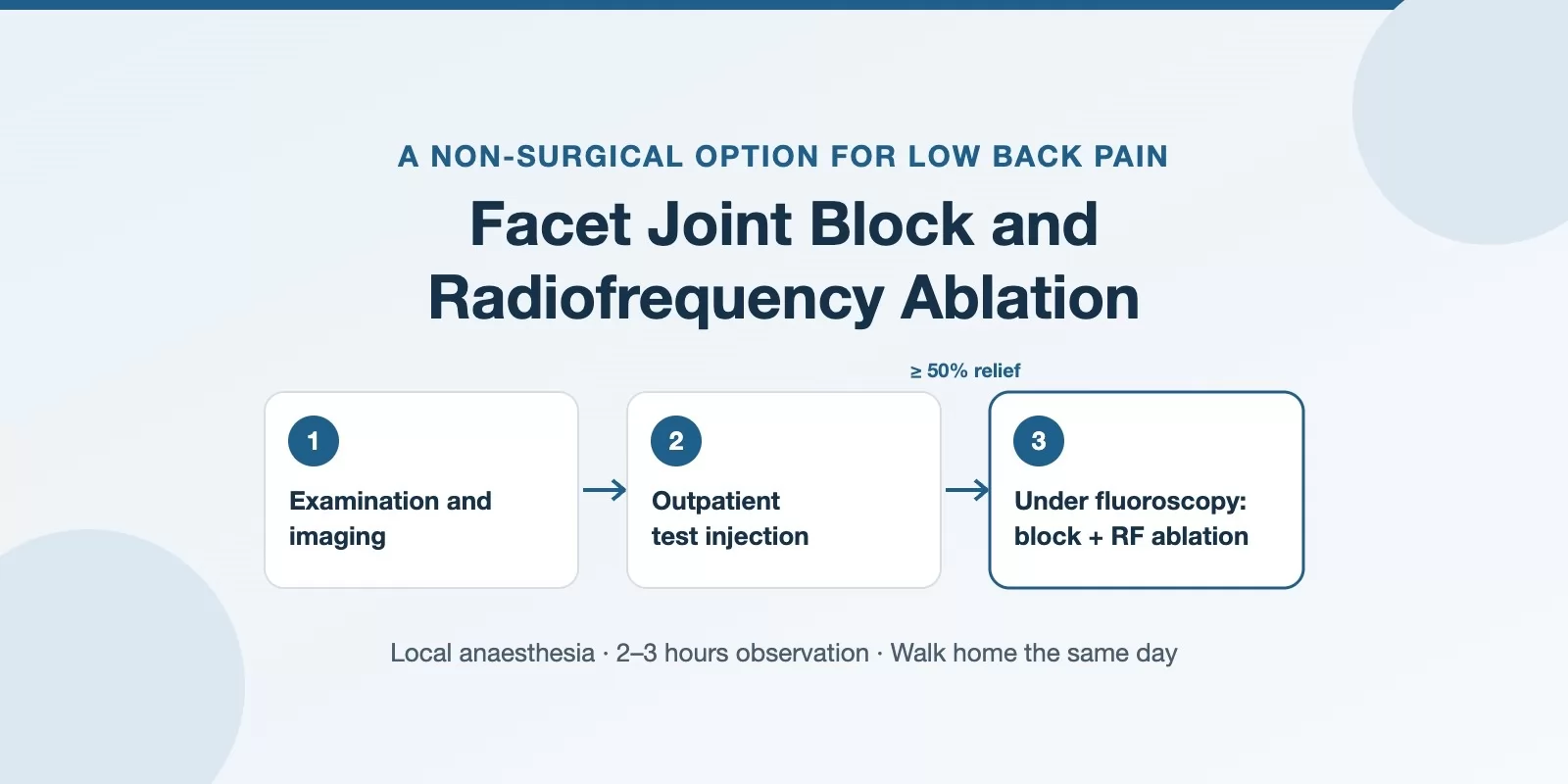
Short answer: Facet joints are small joints at the back of the vertebrae that allow the spine to move. Wear and tear (arthritis) in these joints is one of the common causes of chronic pain that is concentrated in the lower back and does not spread down the leg. To find out whether the pain comes from these joints, a short-acting local test injection is first performed in the outpatient clinic. In patients whose pain temporarily decreases by at least half after this test, facet joint / medial branch block, radiofrequency ablation and a cortisone injection are performed in the same session, in the operating room and under fluoroscopy (live X-ray). The aim is to reduce, for a long time, the pain signals carried by the thin nerve branches of the joint. This procedure is not surgery. Patients can walk home after a few hours of observation.
What Is a Facet Joint and Why Does It Cause Pain?
Each vertebra is connected to the vertebrae above and below by two facet joints, one on each side at the back. Like the knee or hip joint, these joints are covered with cartilage and contain joint fluid. With age, loss of disc height or increased load on the spine, cartilage wear, bony spurs and inflammation can develop in these joints. This condition is called facet arthropathy or facet syndrome.
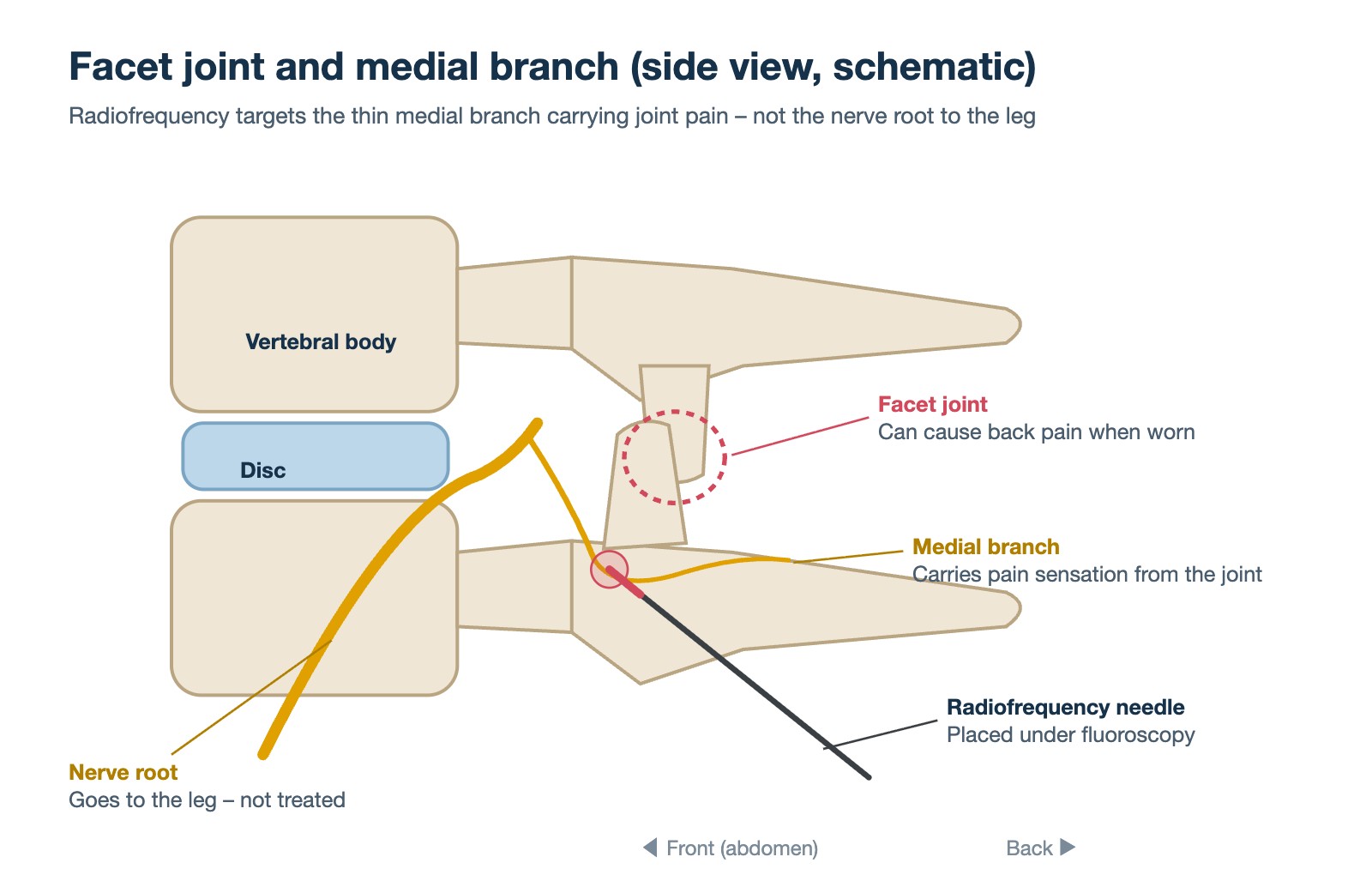
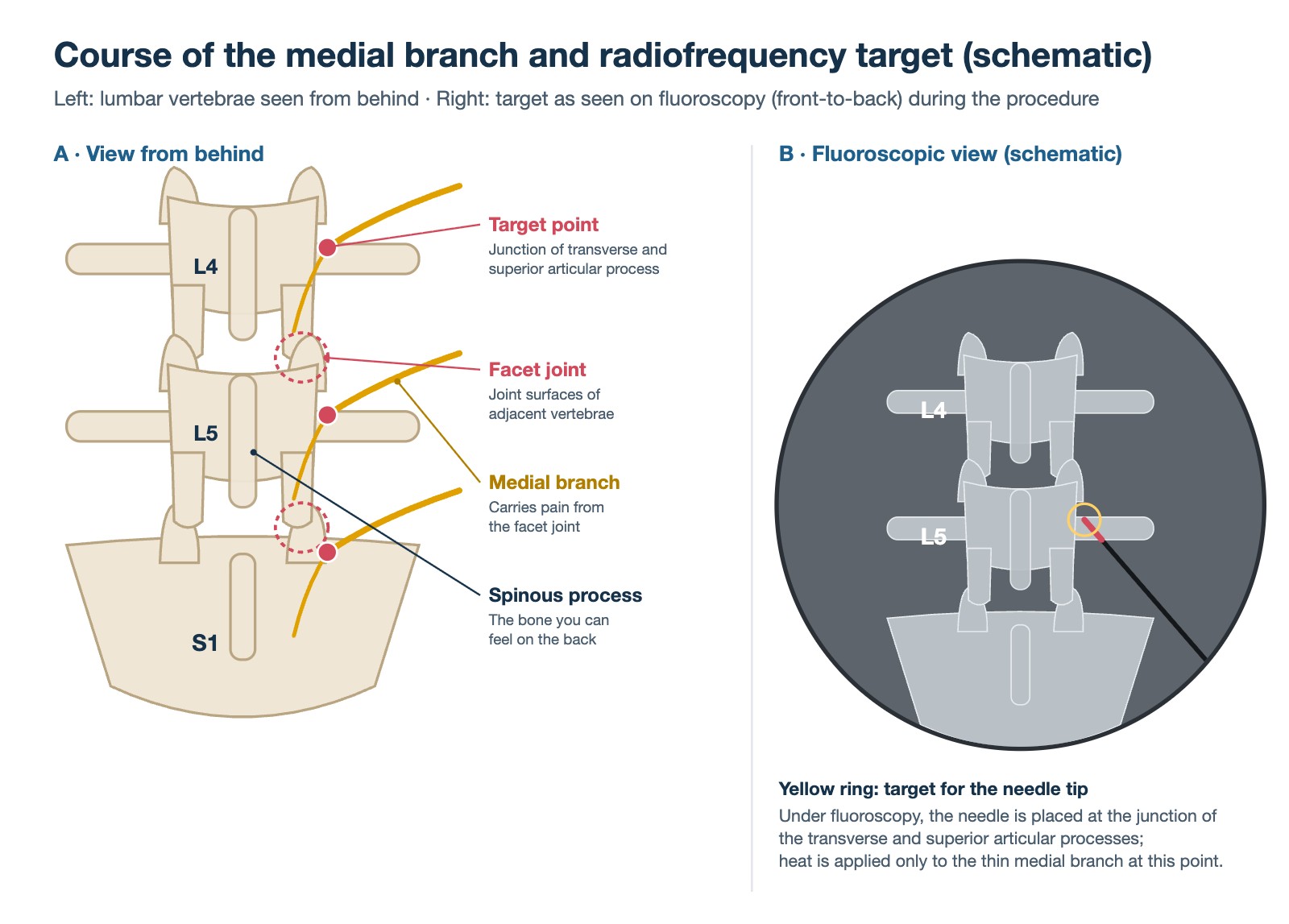
Pain from the facet joints is carried by thin nerve branches called "medial branches". These branches do not control leg movements or muscle strength; their main role is to carry sensation from the joint. Blocks and radiofrequency procedures target these thin branches.
Symptoms of Facet Joint Low Back Pain
Facet pain cannot be recognised by a single symptom. Still, some features suggest it:
- Pain concentrated on one or both sides of the lower back that does not go below the knee
- Pain that may spread to the buttock or the back of the thigh, but does not reach the foot as in a herniated disc
- Stiffness in the lower back on getting up in the morning; pain that eases somewhat with movement
- Pain that increases when bending backwards, twisting to the side or standing for a long time
- No numbness, tingling or weakness in the leg
If the pain radiates down the leg, especially below the knee and into the foot, or if there is numbness or weakness, nerve root compression (herniated disc, spinal stenosis) is considered first and the treatment approach changes. If an epidural injection targeting the nerve root is needed, the patient is referred to a pain medicine (algology) specialist.
How Is the Decision Made? The Outpatient Local Test Injection
The hardest question in facet joint pain is whether the arthritis seen on MRI or X-ray is really the source of the pain. Many people with marked facet arthritis have no pain at all. On the other hand, some patients whose imaging looks fairly harmless may have pain coming from the facet joints.
For this reason, we base the treatment decision not on imaging but on the response to the test injection:
- The area that may be responsible for the pain is identified from the examination and imaging findings.
- In the outpatient clinic, a small amount of local anaesthetic (numbing medicine) is injected into this area. The procedure is short.
- In the hours after the injection, the patient monitors the change in pain, especially by trying movements that used to cause pain.
- In patients whose pain temporarily decreases by 50% or more, the pain is considered to come largely from the facet joints and radiofrequency treatment is planned.
- In patients who do not benefit meaningfully from the test injection, another source of pain is investigated and other treatment options are discussed.
The effect of the test injection lasts only a few hours and it is not a treatment. Its main purpose is to identify patients who are likely to benefit from radiofrequency. A consensus guideline published in 2020 by an international working group also emphasised that selecting patients with a test block before radiofrequency improves outcomes.
What Is Radiofrequency Ablation?
Radiofrequency ablation (also known as radiofrequency denervation or rhizotomy) is the application of controlled heat from the tip of a thin needle to the medial branches supplying the painful facet joints. The heat reduces the ability of these nerve branches to carry pain signals for a long period.
Important features of the procedure:
- It is applied only to the thin branches carrying joint sensation, not to the nerves that move the leg muscles.
- Before heat is applied, the needle position is checked with fluoroscopy and, when needed, with an electrical stimulation test.
- Because the nerve branches can regenerate over time, the effect is limited and the pain may return months later. In patients who clearly benefited from a previous procedure, it can be repeated.
How Is the Procedure Performed?
For patients who benefit from the test injection, the procedure is done in a single session in the operating room:
- Under sterile conditions in the operating room, the patient lies face down. The skin is cleaned and numbed with local anaesthetic.
- The procedure is done with local anaesthesia only; general anaesthesia or sedation is not needed. The patient is awake throughout, so they can tell the doctor what they feel during the electrical stimulation test.
- Under fluoroscopy (live X-ray), the needles are placed at the facet joint and medial branch areas of the levels responsible for the pain.
- In the same session, the following are performed in order:
- Facet joint / medial branch block: the area is numbed with local anaesthetic.
- Radiofrequency ablation: after the position of the needle tip is confirmed, controlled heat is applied briefly at each level.
- Cortisone injection: a cortisone-type medicine is given to reduce inflammation around the joint.
- Depending on how widespread the pain is, up to 5–6 levels can be treated in one session, so wear at several levels can be addressed in a single procedure.
- After the procedure, the patient stays under observation for 2–3 hours and then walks home. Not driving and resting on the day of the procedure is recommended.
After the Procedure
- Thanks to the cortisone and local anaesthetic, pain relief may be felt in the first days.
- In the first 1–2 weeks there may be burning, tenderness or a temporary increase in pain at the procedure site. The main effect of radiofrequency usually becomes clear after this period.
- This period of reduced pain is a good opportunity to start an exercise and physiotherapy programme. In the long term, strengthening the trunk muscles and building correct posture and movement habits are important.
What Do Recent Studies Say?
Results of studies on facet joint radiofrequency ablation are not all in one direction. To inform our patients properly, we share both supporting and questioning evidence:
- Supporting evidence: A meta-analysis published in 2024 combined only 8 placebo-controlled randomised trials. In this analysis, radiofrequency ablation provided significant improvement compared with a sham procedure in pain in the short, medium and long term (more than 12 months), and in function in the short and long term. An effect on quality of life could not be clearly shown.
- In a recent multicentre randomised trial published in Spine, patients whose facet pain was confirmed with test blocks received radiofrequency ablation, cryoablation or endoscopic denervation. All three methods provided marked improvement in low back pain and function at 2-year follow-up; the most consistent long-term relief was seen in the radiofrequency group.
- Questioning evidence: In the MINT trials published in JAMA in 2017 and conducted at 16 centres in the Netherlands, adding radiofrequency to a standard exercise programme did not provide a clinically meaningful additional benefit in facet low back pain. Although this study has been criticised for patient selection and technique, it is important evidence.
- An international clinical practice guideline published in the BMJ in 2025 recommended against the routine use of interventional procedures, including radiofrequency, for chronic low back pain lasting more than 3 months that does not spread to the leg. The guideline also stressed that the effect should be studied separately in different pain subgroups.
We can summarise this as follows: radiofrequency ablation is not a procedure for every case of low back pain. The patients most likely to benefit are those whose examination suggests facet joint pain, who have no problem requiring surgery, whose pain continues despite exercise and medication, and who clearly benefit from the test injection. For this reason, we do not decide on the procedure before seeing the response to the outpatient test injection.
Who May Not Be Suitable?
- Patients with pain radiating down the leg, numbness or weakness (nerve root compression is evaluated first)
- Patients who do not benefit meaningfully from the test injection
- Those with an active infection at the procedure site or elsewhere in the body
- Patients with a bleeding disorder or who cannot safely stop blood thinners
- Pregnant women
- Patients with a pacemaker or similar electronic device (special evaluation and preparation are needed)
- Those with a spinal problem that needs different treatment, such as instability, fracture, tumour or infection
In patients with diabetes, cortisone can raise blood sugar for a few days. For this reason, blood sugar control is reviewed with the doctor before the procedure.
Possible Side Effects
When performed under fluoroscopy, serious complications are rare. Possible effects include:
- Pain, tenderness or bruising at the needle site lasting a few days
- A temporary burning sensation or increase in pain in the first weeks after radiofrequency
- Temporary numbness of the skin
- Cortisone-related facial flushing, hot flushes, changes in sleep, or a temporary rise in blood sugar in patients with diabetes
- Rarely, infection or bleeding
Medications (especially blood thinners), allergy history and chronic illnesses must be shared with the doctor before the procedure.
Frequently Asked Questions
What is the difference between the outpatient test injection and the procedure in the operating room?
The outpatient test injection is a test to find out whether the pain comes from the facet joints, and its effect lasts a few hours. In the operating room procedure, block, radiofrequency ablation and cortisone injection are applied together in the same session under fluoroscopy. The aim of this procedure is to reduce pain for a longer time.
I have arthritis at several levels. How many separate procedures will I need?
A single session is enough for most patients. Depending on how widespread the pain is, up to 5–6 levels can be treated in the same session.
Will I be put to sleep during the procedure?
No. The procedure is done with local anaesthesia and the patient is awake throughout. Because the areas where the needles enter are numbed, the procedure is usually well tolerated.
Do I need to stay in hospital after the procedure?
Usually not. Patients can walk home after 2–3 hours of observation. Not driving on the day of the procedure is recommended.
How long does the effect last, and can it be repeated?
It varies from person to person. Because the nerve branches can regenerate, the pain may return months later. In patients who clearly benefited from a previous procedure, it can be repeated.
Can radiofrequency cause weakness in my leg?
The procedure is applied to the thin branches carrying sensation from the facet joint, not to the nerves that move the leg muscles. The needle position is checked during the procedure with fluoroscopy and an electrical stimulation test.
I also have a herniated disc. Is this procedure suitable for me?
This depends on the source of your pain. If pain radiating down the leg is the main problem, the cause is most likely in the nerve root and a different treatment is needed. If pain concentrated in the lower back is the main problem, part of the pain may come from the facet joints even if there is a herniation. Examination and the test injection make it possible to tell these apart.
References
- Cohen SP, Bhaskar A, Bhatia A, et al. Consensus practice guidelines on interventions for lumbar facet joint pain from a multispecialty, international working group. Reg Anesth Pain Med. 2020;45(6):424–467. doi:10.1136/rapm-2019-101243
- Láinez Ramos-Bossini AJ, Jiménez Gutiérrez PM, Ruiz Santiago F. Efficacy of radiofrequency in lumbar facet joint pain: a systematic review and meta-analysis of placebo-controlled randomized controlled trials. Radiol Med. 2024;129(5):794–806. doi:10.1007/s11547-024-01809-8
- Kočan L, Rapčan R, Mláka J, et al. Comparative effectiveness of radiofrequency ablation, cryoablation, and endoscopic denervation for lumbar facet pain: a multicenter trial. Spine. 2026;51(1):1–8. doi:10.1097/BRS.0000000000005539
- Juch JNS, Maas ET, Ostelo RWJG, et al. Effect of radiofrequency denervation on pain intensity among patients with chronic low back pain: the Mint randomized clinical trials. JAMA. 2017;318(1):68–81. doi:10.1001/jama.2017.7918
- Busse JW, Genevay S, Agarwal A, et al. Commonly used interventional procedures for non-cancer chronic spine pain: a clinical practice guideline. BMJ. 2025;388:e079970. doi:10.1136/bmj-2024-079970
Related: How is low back pain treated? · Spondylolisthesis: symptoms, types and treatment
Disclaimer: This content is for general information only and does not replace a medical examination. Diagnosis and treatment are individual. If you have complaints, please consult a doctor.
Prof. Dr. Akif Albayrak — Orthopaedic and Trauma Surgeon, Spine Surgeon