

Spondylolisthesis is a condition in which one of the lumbar vertebrae slips forward over the vertebra below it. It is most commonly seen in two forms: isthmic spondylolisthesis, which develops in young people because of a crack in the back part of the vertebra, and degenerative spondylolisthesis, which develops after the age of 50 because of wear in the joints and discs. Many people with spondylolisthesis have no symptoms at all, or their symptoms are controlled with non-surgical treatment. Surgery is considered when leg pain, shortening of walking distance or weakness continue despite non-surgical treatment.
Types of spondylolisthesis at a glance
| Isthmic spondylolisthesis | Degenerative spondylolisthesis | |
|---|---|---|
| Cause | A crack in the back arch of the vertebra (spondylolysis) | Age-related wear of the facet joints and discs |
| Typical age | Childhood, adolescence, young adulthood | Usually over 50, more common in women |
| Most common level | L5 – S1 | L4 – L5 |
| Typical complaint | Low back pain, pain that increases with sports, tight hamstrings | Leg pain and numbness when walking, shorter walking distance (spinal stenosis) |
| Amount of slip | Can range from mild to severe | Usually mild (grade 1) |
What is spondylolisthesis?
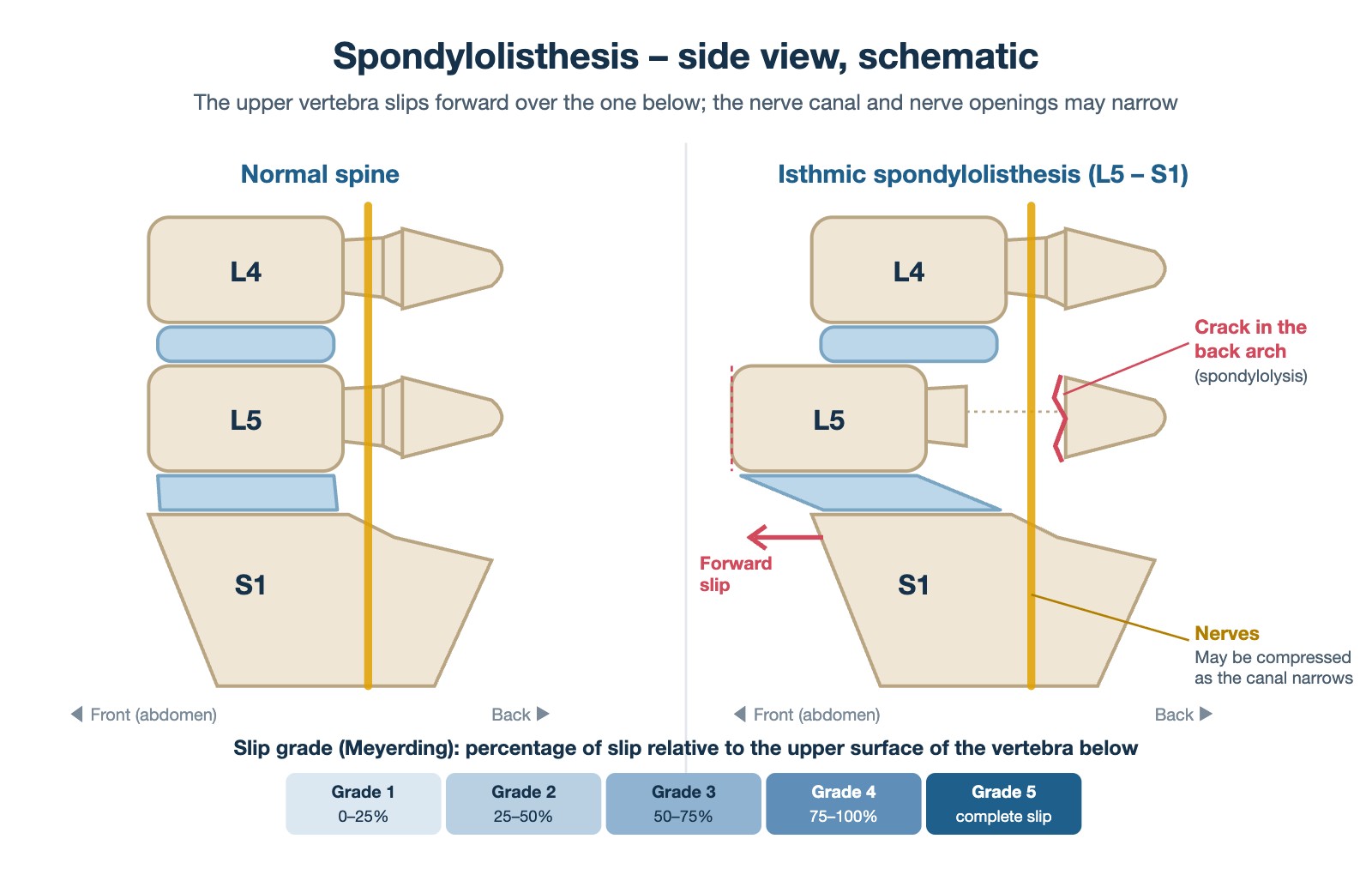
The spine is made of vertebrae stacked on top of each other. Each vertebra is connected to the one below by the disc in front and two small joints at the back (facet joints). When one of these connections weakens, the upper vertebra can slip forward over the lower one. This is called spondylolisthesis.
The slip can narrow the canal that carries the nerves and the openings through which the nerves exit. Leg pain, numbness and early fatigue when walking, in addition to low back pain, are caused by this narrowing.
Types of spondylolisthesis
- Isthmic spondylolisthesis: Develops when a crack forms in the thin bony bridge at the back of the vertebra (pars interarticularis). This crack is called spondylolysis. It is common in children and young people who do sports that repeatedly bend the back backwards (gymnastics, ballet, wrestling, weightlifting, volleyball, football goalkeeping and similar).
- Degenerative spondylolisthesis: With age, wear in the facet joints and the disc loosens the structures that hold the vertebra in place. It is usually seen after 50, most often at the L4-L5 level, and frequently occurs together with lumbar spinal stenosis (our article on lumbar spinal stenosis).
- Congenital (dysplastic) spondylolisthesis: Caused by vertebrae that develop differently from birth; it is noticed in childhood and needs close follow-up because the slip can progress.
- Other causes: Major trauma, diseases that weaken bone and previous back surgery can also cause a slip.
What are the symptoms?
Mild spondylolisthesis often causes no symptoms and is found by chance on an X-ray taken for another reason. When it does cause symptoms, the most common are:
- Low back pain that increases with standing, long walks and bending backwards
- Pain, numbness or tingling spreading from the buttock to the leg, sometimes down to the foot
- Pain and heaviness in the legs when walking, relieved by sitting or bending forward (a sign of spinal stenosis)
- In young people, marked tightness of the muscles at the back of the thigh (hamstrings) and difficulty bending forward
- In severe slips, a step felt in the lower back and a change in posture
If weakness in the leg, numbness around the groin and buttocks, or problems controlling the bladder or bowels develop, urgent medical evaluation is needed without delay.
How is it diagnosed and graded?
The diagnosis is made by examination and a standing X-ray of the lower back. The amount of slip is measured as a percentage of the upper surface of the vertebra below and graded (Meyerding classification):
- Grade 1: up to 25% slip
- Grade 2: 25 – 50%
- Grade 3: 50 – 75%
- Grade 4: 75 – 100%
- Grade 5 (spondyloptosis): the vertebra has fallen completely in front of the one below
Flexion-extension X-rays, taken while bending forward and backward, show whether the vertebra moves abnormally (instability). MRI shows how much the nerves and canal are narrowed; computed tomography (CT) shows the crack in the back arch in detail, especially in young patients.
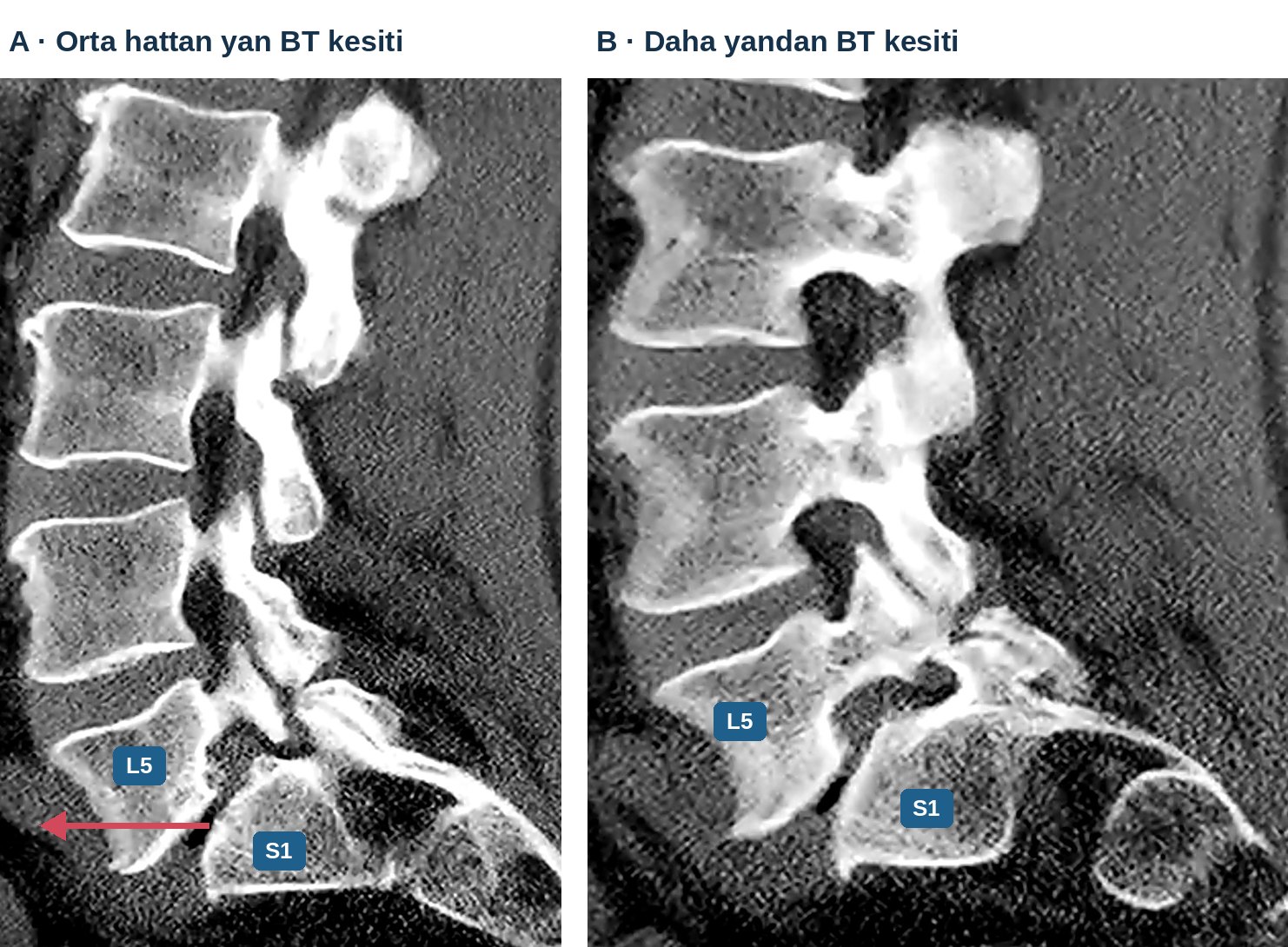
The image is shared with our patient's consent and with identifying information removed.
Seeing a slip on imaging is not enough on its own to decide on treatment. The decision depends on whether the complaints match the examination and imaging findings.
Non-surgical treatment
For most patients with spondylolisthesis, treatment starts without surgery:
- Exercise and physiotherapy: Programmes that strengthen the deep muscles around the abdomen and lower back and stretch the hamstrings are the basis of treatment.
- Medication: Pain relievers and muscle relaxants can be used for short periods during painful episodes.
- Activity modification: Movements that bend the back backwards and heavy lifting are paused for a while. Complete bed rest is not recommended.
- Weight control and regular walking reduce the load on the lower back.
- Injection treatments: For nerve pain spreading to the leg, the patient is referred to a pain medicine (algology) specialist for an epidural injection targeting the nerve root if needed.
For non-surgical options in general low back pain, see our article on how low back pain is treated.
When is surgery needed?
Surgical treatment is considered in the following situations:
- Low back and leg pain that clearly limits daily life despite regular non-surgical treatment
- Progressive shortening of walking distance (spinal stenosis)
- Weakness in the leg or signs of progressive nerve damage
- A slip that is progressing or severe, especially in children and young people
- Loss of bladder or bowel control (an emergency)
In a large study of patients with degenerative spondylolisthesis and spinal stenosis, patients who had surgery showed greater improvement in pain and function over 2 years than those followed without surgery [1]. In adults with isthmic spondylolisthesis whose complaints had lasted more than a year, surgery was also reported to provide greater improvement in pain and function than an exercise programme [2].
How is spondylolisthesis surgery performed?
The aim of surgery is to relieve the compressed nerves and, when needed, to stabilise the slipped vertebra:
- Decompression: Bone and ligament pressing on the nerves are removed to widen the canal and nerve openings.
- Fusion (stabilisation): The slipped vertebra is fixed to the vertebra below with screws and rods; over time the two vertebrae heal together into bone. If needed, a support (cage) is placed between the two vertebrae in place of the disc.
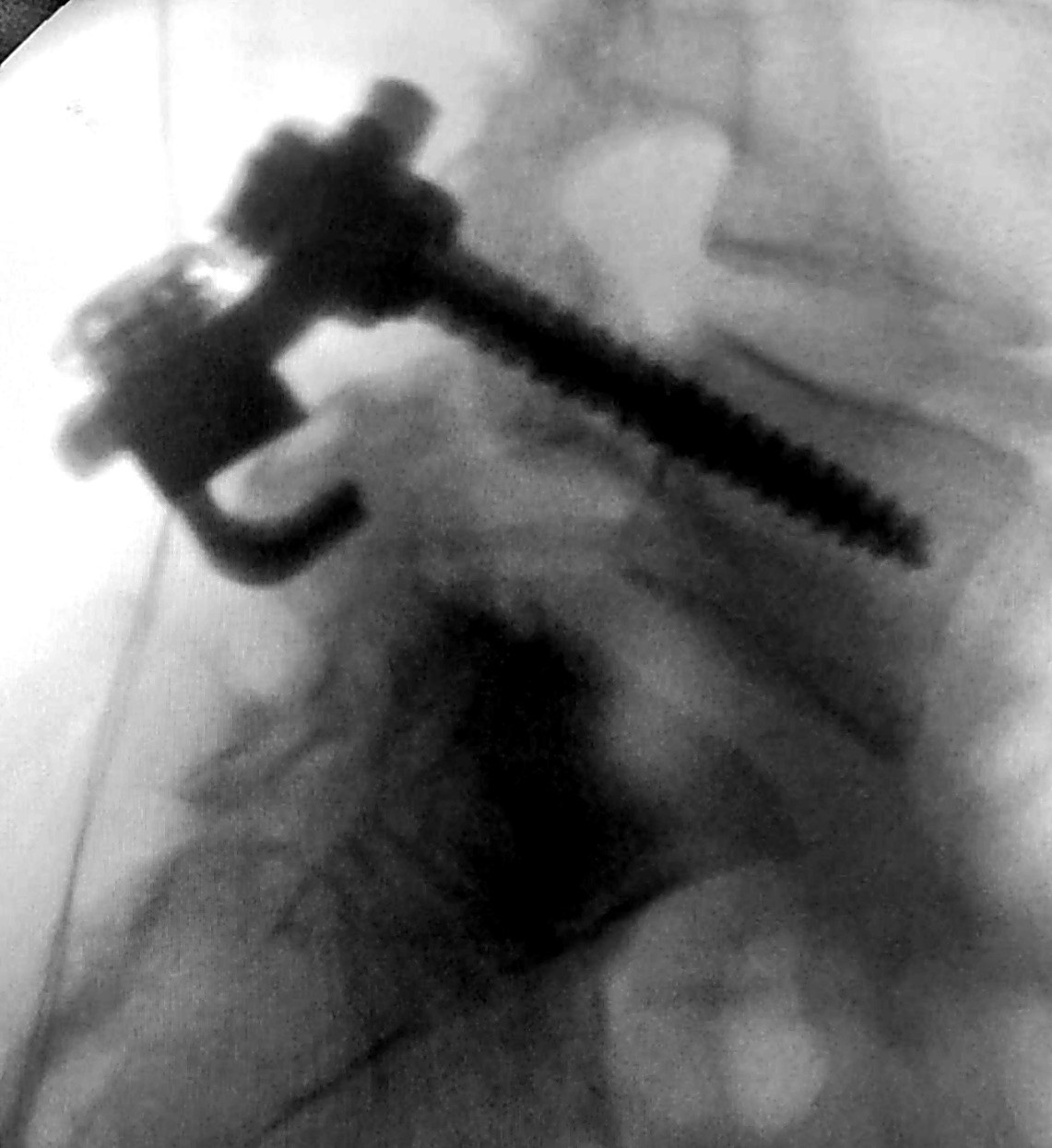
The image is shared with our patient's consent and with identifying information removed.
In degenerative spondylolisthesis, whether decompression alone or decompression combined with fusion is more appropriate has been studied for a long time. Of two important studies published in the same year, one found that adding fusion gave slightly greater improvement in quality of life and reduced the reoperation rate [3], while the other found similar results for the two methods at 2 and 5 years [4]. For this reason the method is chosen for each patient individually: movement of the vertebra on flexion-extension X-rays, the grade of the slip, whether low back pain is the main complaint and the patient's general health guide this decision.
Spondylolisthesis in children and young people
Low back pain lasting more than a few weeks in a child or young person who plays sports, especially if it increases when bending backwards, should be evaluated for a crack in the back arch (spondylolysis). In cracks found early, a break from sports, a suitable exercise programme and, if needed, a brace can allow the crack to heal. Because the slip can progress during growth, regular check-ups are important. Surgery may be needed for progressive or severe slips.
Living with spondylolisthesis
- Do exercises that strengthen your back and abdominal muscles regularly.
- Choose sports that put little load on the lower back, such as swimming and walking.
- When lifting heavy objects, bend your knees and keep your back straight.
- If you have to stand for a long time, take breaks; rest by sitting or bending slightly forward.
- Lose excess weight and stop smoking.
Frequently Asked Questions
Does spondylolisthesis go away on its own?
A slipped vertebra does not return to its original position on its own. However, most mild slips do not progress, and symptoms can be controlled with exercise and non-surgical treatment.
Is spondylolisthesis the same as a herniated disc?
No. In a herniated disc, the inner material of the disc between the vertebrae bulges out; in spondylolisthesis, the vertebra itself moves forward. Both can occur in the same person and can cause similar leg pain. For details, see our article on herniated discs.
Can someone with spondylolisthesis do sports?
Most patients can do suitable sports. Swimming, walking and strengthening exercises recommended by a doctor or physiotherapist are usually appropriate. Sports that repeatedly bend the back backwards or involve heavy loads should be paused during painful periods and discussed with your doctor.
When can I walk after spondylolisthesis surgery?
Patients usually walk the day after surgery. Return to daily activities and desk work may be possible within a few weeks; return to heavy work and sports takes longer, depending on the progress of bone healing. Recovery varies from person to person.
Can spondylolisthesis cause paralysis?
Because spondylolisthesis occurs below the level where the spinal cord ends, it does not cause paralysis of the body. However, severe nerve compression can cause weakness in the legs and, rarely, problems with bladder and bowel control. If these symptoms develop, urgent evaluation is needed.
References
- Weinstein JN, Lurie JD, Tosteson TD, et al. Surgical versus nonsurgical treatment for lumbar degenerative spondylolisthesis. N Engl J Med. 2007;356(22):2257-2270. doi:10.1056/NEJMoa070302
- Möller H, Hedlund R. Surgery versus conservative management in adult isthmic spondylolisthesis – a prospective randomized study: part 1. Spine. 2000;25(13):1711-1715. doi:10.1097/00007632-200007010-00016
- Ghogawala Z, Dziura J, Butler WE, et al. Laminectomy plus fusion versus laminectomy alone for lumbar spondylolisthesis. N Engl J Med. 2016;374(15):1424-1434. doi:10.1056/NEJMoa1508788
- Försth P, Ólafsson G, Carlsson T, et al. A randomized, controlled trial of fusion surgery for lumbar spinal stenosis. N Engl J Med. 2016;374(15):1413-1423. doi:10.1056/NEJMoa1513721
Disclaimer: This content is for general information only and does not replace examination, diagnosis or treatment. Please consult a doctor about your complaints.
Prof. Dr. Akif Albayrak — Orthopaedic and Trauma Surgeon, Spine Surgeon